
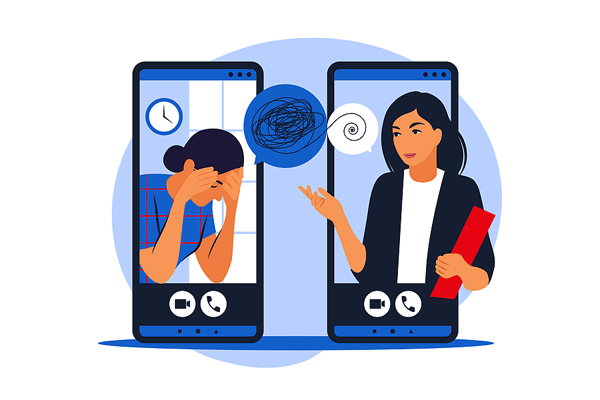

I expected telehealth to be used mainly for counseling and mental health services, but I was surprised to learn how widely it is used in social work. The authors discussed using telehealth for housing assistance, crisis intervention, and connecting clients to community resources, which I had not considered before. I usually think of telehealth as something used in healthcare settings, so it was interesting to see its broader applications. This showed me that telehealth can support many different areas of social work practice (Balogun et al., 2025).
I agree with the authors’ discussion about the benefits of telehealth for vulnerable populations. Telehealth can reduce barriers such as transportation issues, distance, mobility limitations, and scheduling conflicts. It also allows clients to access services from the comfort and privacy of their own homes. This can be especially helpful for individuals living in rural areas, people with disabilities, and those who may feel uncomfortable seeking in-person services (Balogun et al., 2025).
One area I think the authors could have discussed more was the use of telehealth in schools. School social workers may use virtual meetings to provide counseling, communicate with families, or support students who cannot attend school in person. Since telehealth is becoming more common in educational settings, I think including this example would have strengthened the discussion. It would also show another way telehealth can increase access to services for children and families.
In my opinion, the most significant challenge regarding telehealth is the digital divide. Even though telehealth can increase access to services, it is not helpful if clients lack reliable internet, devices, or the skills to use technology. This issue can disproportionately affect low-income families, older adults, and people living in rural communities. Without addressing these barriers, some of the population that needs services the most may still be left out (Balogun et al., 2025).
What surprised me most was how quickly practitioners adapted to using telemedicine during the COVID-19 pandemic. The study found that daily telemedicine use more than doubled, and many providers became more comfortable using it over time (Zhu et al., 2024). I expected some increase in use, but I did not expect such a dramatic shift in a relatively short period. This surprised me because major changes in practice often take much longer to implement.
The use of telemental health was higher than I expected. Before reading this article, I assumed that many providers would still prefer in-person services and use telemedicine only occasionally. However, the study found that more than half of providers served over 50% of their caseload through telemedicine during the pandemic (Zhu et al., 2024). This demonstrated how quickly it adjusted to meet the client’s needs during a crisis.
Two factors that influenced practitioners’ plans to continue using telemedicine were geographic location and client preferences. Providers working in rural communities were more likely to expect continuous telemedicine because it helps increase access to services for individuals who might otherwise not receive care (Zhu et al., 2024). Client preferences were also important, as providers reported that clients’ willingness to receive services virtually influenced their decision to continue offering telehealth. These findings suggest that both accessibility and client satisfaction play a role in the future of telemedicine.
Personally, I believe telehealth can be a valuable tool in social work practice when used appropriately. It can increase access to services for clients who face barriers such as transportation issues, distance, or scheduling conflicts. At the same time, I think it is important to recognize that telehealth may not be the best option for every client or situation. Ideally, I would support a combination of in-person and virtual services so that clients can receive care in the format that best meets their needs.
Reference:
Balogun, O., et al. (2025). Integrating telehealth services in social work practice for vulnerable groups. World Journal of Advanced Research and Reviews, 25(1), 1984-1991. https://wjarr.com/content/integrating-telehealth-services-social-work-practice-vulnerable-groups
Zhu, D., Paige, S. R., Slone, H., Gutierrez, A., Lutzky, C., Hedriana, H., Barrera, J.F., Ong, T., & Bunnell, B.E. (2024). Exploring telemental health practice before, during, and after the COVID-19 pandemic. Journal of Telemedicine and Telecare, 30(1), 72-78. https://pmc.ncbi.nlm.nih.gov/articles/PMC10375824/
I also agree with you that the digital divide is one of the most concerning challenges. Even if clients have access to the internet through a public library or another public space, it may not be very useful. Clients may not feel comfortable discussing personal information where others can hear them. Privacy and confidentiality are so important it can make it difficult for clients to fully open up. I think this is an issue that definitely needs to be addressed on a broader level.
Nelly,
I think you make a good point about telehealth in school settings. The authors didn’t discuss that – and I suspect it’s because there weren’t many studies or articles at that time. And that would have been an important element during the pandemic, as we are certainly seeing post-pandemic. And the movement toward remote learning has certainly changed all education – including social work education.
I believe that the pace with which telehealth has been accepted in social work practice was, in part, influenced by the intensity of the need. We were thrust into a new environment – like it or not. I worked with older adults, so for me, the ability to get them connected felt a lot like life and death. When there is that kind of intensity, I think the process speeds up.
Good discussion.
Dr P