

Balogun, et. al. (2025)
The presence of telehealth described in Balogun, et. al. (2025) is what I expected. The article discusses the benefits of telehealth services, including more accessibility for those experiencing barriers. The authors acknowledged that while telehealth has its advantages, there are still some areas that need to be addressed, including how telehealth creates barriers for low-income and marginalized communities who may not have access to internet or the technology to use telehealth, which increases the challenges they are already facing. In my experience as a case manager, I find that statement to be true. Some of the families I serve do benefit from telehealth, while others find it more challenging as they do not have internet or the technology to utilize telehealth. With that being said, I agree and disagree with the discussion about the benefits for telehealth for vulnerable populations. While telehealth has reduced some barriers in access to services for the vulnerable population, there are still challenges that need to be addressed. As the use of telehealth increases, I hope that it becomes more equally accessible.
I believe the article should have included how telehealth may hinder social workers from having therapeutic relationships with their clients. As I have discussed in previous discussions, some individuals value face-to-face connection. It also may be challenging to build rapport with clients virtually. The article should have also included how telehealth can be challenging for children. As a case manager, I notice that children have a difficult time engaging in virtual sessions with their provider. Children like to play, run around, etc., while in sessions. I imagine it be difficult for a child to sit in one place during a virtual session. The article also should have included the lack of privacy when using telehealth. The authors included the benefits for domestic violence victims, however, they did not consider how some individuals do not have a safe place to use telehealth. In that case, I do not believe telehealth is the safest option.
In my opinion, the most significant challenge regarding the use of telehealth is technology access and the digital divide. As stated in the article, many individuals do not have access to internet services or may not have the technology to use telehealth, which still creates barriers for vulnerable individuals accessing resources, Balogun, et. al. (2025). As the use of technology and telehealth increases, I think it is important for social workers to consider ways to advocate for resources that help bridge the gap and make it more accessible for all no matter their background or circumstance. Unfortunately, with any new trend or advancement, comes challenges or barriers, the important things is helping individuals overcome those challenges.
Zhu, et. al. (2024)
I was not surpised by the response of practitioners. Telehealth eliminated many barriers to receiving mental health services, and increased the access for individuals who had limited access initially. I believe the advantages influenced the decision to continue telehealth services. Practitioners became more confident in service delivery and clients appreciated the convenience.
The article discussed several variations regarding the use of telemedicine post pandemic. One factor that influenced the decision to continue using telemedicine is the impact it made in rural communities. Practitioners realized how telemedicine helped bridge the gap in access to mental health services. Continued use of telemedicine ensured ongoing access to resources and improvement in mental health care. Another factor that influenced the decision is health insurance coverage and reimbursement. The article discussed concerns regarding insurance coverage which influenced decision on whether they would continue providing telemedicine. As a case manager, I have witnessed many of my clients have difficulty finding telemedicine providers who accept Medicaid, which aligns with the articles discussion on some providers preferring self-pay clients because they do not have to navigate the process of health insurance. In my opinion, this serves as a need to address how to make the insurance process easier, so that individuals who cannot afford to pay out of pocket have greater access to mental health services.
As a case manager, every family I serve has their own unique circumstances, so the decision to use telehealth in my practice would be based on their needs. Telehealth has many advantages, however it not yet eqaully accessible for all and still has challenges that should be addressed. In my opinion, telehealth should be used on a case by case basis.
References
Balogun, A. K., Dada, S. N., Kazeem, O., & Bakare-Adesokan, K. A. (2025). Integrating telehealth services in social work practice for vulnerable groups. World Journal of Advanced Research and Reviews, 25(1), 1984-1991. https://doi.org/10.30574/wjarr.2025.25.1.0248
Zhu, D., Paige, S. R., Slone, H., Gutierrez, A., Lutzky, C., Hedriana, H., Barrera, J. F., Ong, T., & Bunnell, B. E. (2024). Exploring telemental health practice before, during, and after the COVID-19 pandemic. Journal of telemedicine and telecare, 30(1), 72–78. https://doi.org/10.1177/1357633X211025943
Hello,
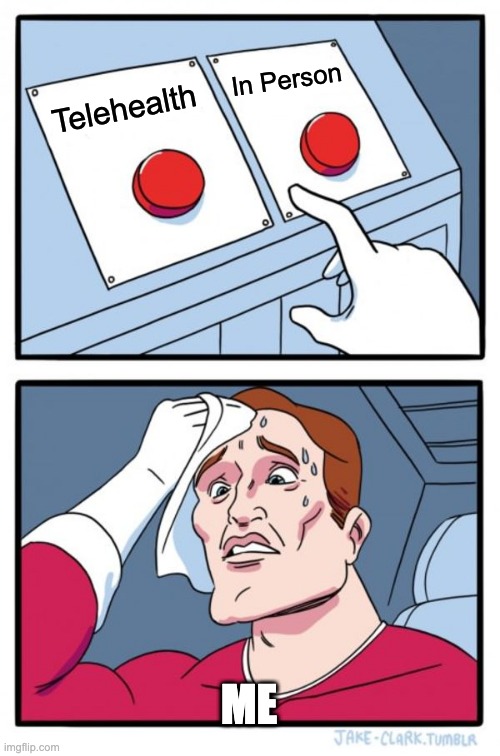
I have to acknowledge how amazing the image you chose is! It is truly a fitting image for this week’s readings and discussions. I appreciate that throughout this post, you tied much of your responses to your own real-life experience as a social worker. We shared similar sentiments regarding telehealth. We both see its value but also recognize its challenges and potential for growth. Like you, I question my ability to build rapport with clients when all interactions take place virtually. In addition, I felt the element of privacy should have been discussed in more detail. For safety and uninterrupted sessions, it is important that clients can find a place that offers privacy, which may be difficult. I also felt you made a valuable point by noting that telehealth can be challenging for children. Finally, I enjoyed your last paragraph as it acknowledges that telehealth will not work for every client and every case, so social workers must be flexible and willing to accept that it is not a one-size-fits-all approach.
Kierra,
I have enjoyed reading all of your discussions about telehealth and vulnerable populations You have all taken me back to the start of the pandemic, when I had 45 older adults (70 and up) who were totally isolated, afraid, and never heard of Zoom. The ones with resources didn’t have to deal with access to broadband, but they didn’t have a clue how to use that capacity. The ones without resources didn’t have that access, and we made due with cell service on my cellular plan. I go back to all of those challenges when I read your posts.
During that time, I learned a couple of things. First, teaching technology to older adults is both possible and essential – and for the first time, they understood why it was so essential. Second, advocacy does work in a crisis, and the programs provided by the broadband companies – financially supported by several bills (COVID act and the infastructure act) – made the difference for most of my older adults without resources. Third, people without resources tend to be more resourceful. I don’t know if that makes sense, but I found my lower income older adults always finding a way – as time went on, on their cell phones. Some of those programs continue today and many of those older adults – particularly the younger olders are using the cell phones to participate. You are totally correct that there is work left to do regarding access and this administration has made that work more difficult.
In terms of the impact on the therapeutic relationship, remember that these authors were doing a literature review. The did talk a bit about how clients felt about telehealth, particularly young people, but there wasn’t much literature about the therapeutic relationship and telehealth at that point. In the literature I have seen (we do read one article in the more extended version of this class), the clients felt more connected to their therapist and that they were more available. It was the professional who was more concerned about the impact of remote contact.
Safety is always an important issue, and there were many professionals during the pandemic who would not do safety checks on children using remote contact. They just figured out ways to meet in person. I remember many days sitting in the driveways of my older adults while I set up their tablets and then exchanged and explained on their front porch. We made due. But you are correct, advocacy matters.
The issue of insurance hasb een with us and will be as long as we continue to provide health care the way we do. When you talk about access to mental health services the group of vulnerable clients grows exponentially, right? Resources don’t necessarily get you mental health services unless you have a whole lot of them.
And you make an excellent final point – let’s start where the client is.
Nice discussion.
Dr P