

Part 1
I have encountered generative AI in more places than I realize without really understanding how it works. I have used AI chat boxes that pop up on different websites whenever I need help finding information or have questions about a service. I have also used Gmail’s built-in AI features to suggest ways to improve or rewrite my emails. Before reading Kalota’s article, I never really thought about how these AI tools were being used to assist me. I just wanted to use the services offered to me.
I am very comfortable with AI showing up in social work practice. As Kalota states, “generative AI is here to stay for the long run. Whether we like it or not, people will continue to use it. The bad actors in society will also continue to use it. So, various stakeholders, such as governments, businesses, and academic institutions, must collaborate to educate businesses and society on the healthy use of such tools and ensure the tools are not misused” (Kalota, 2024, p.12). I agree with this perspective because AI is not going away and should be embraced. I believe that social workers should learn how to use it ethically. Social workers bring much to the field that AI cannot replace, including critical thinking skills and the relationships they build with clients and communities. AI can improve efficiency, support certain administrative tasks, and provide access to information. However, it should not replace professional judgment.
If a client or coworker asked me why AI hallucinates or gets something confidently wrong, it’s because AI gets information input like downloading many books but doesn’t know if something is true or not; it’s just retaining information to look for patterns and predict the best answer. Sometimes those answers are correct, and other times AI may fill in missing information with something that sounds believable even though it’s not correct. That is why AI should always be verified, especially in the health care and social work fields.
Part 2
One safeguard I would insist on is that every AI-generated screening or recommendation be reviewed by a qualified provider before important decisions are made about clients’ care. If an individual expresses a mental health crisis or safety concerns, the AI program should immediately alert a human provider instead of trying to manage the situation on its own.
AI is appropriate for lower-risk tasks such as answering general questions, sending appointment reminders and providing psychoeducation. However, therapy, diagnosis, crisis intervention, suicide risk assessment, and treatment planning require human professionals. Moore found that even with advanced AI language models, models could reinforce delusions or provide unsafe responses, which showed me that AI simply cannot be trusted to make decisions independently.
Working as a behavioral health case manager has shown me why oversight matters. I work with individuals with serious mental health conditions. Two people can have the same diagnosis but need different interventions and treatments. Humans can also make mistakes, which is why it’s important for collaboration with humans and AI. As stated before, I support the use of AI in the social work field
I would rate your post a 10/10. My reasoning would be because even though I do not feel comfortable with AI showing up in social work, your response was that you are comfortable with AI in social work because adaptation is necessary because of how widely used AI is becoming, as well as that AI cannot replicate the skills and relationships social workers use and build in person, and this made me feel more empowered.
I give your post a 10/10. This is because even though I have a differing stance from you, your post definitely made me stop and think about the argument you have presented in this post. I am moderately comfortable with AI in social work practice. I say this because I am only comfortable with it as long as the application is not client-facing. I do agree with you and Kalota (2024) that Gen-AI is not going anywhere. As much as I would like to close the proverbial “Pandora’s Box”, as a future with AI does give me some pause for concern, I know that we cannot, no more than we can go back to a time without the internet. As you stated, we must learn how to use it ethically. However, I also believe we must learn when not to use it at all, as I don’t think that AI has a safe and ethical application in all situations.
Asabea,
Your points are all well taken, and I agree with your assessment of AI being here to stay. Our task, as you indicate, is to figure out the ways it can be helpful and the ways we should apply safeguards. We all use it, almost without even realizing it, and that may be exactly part of the problem.
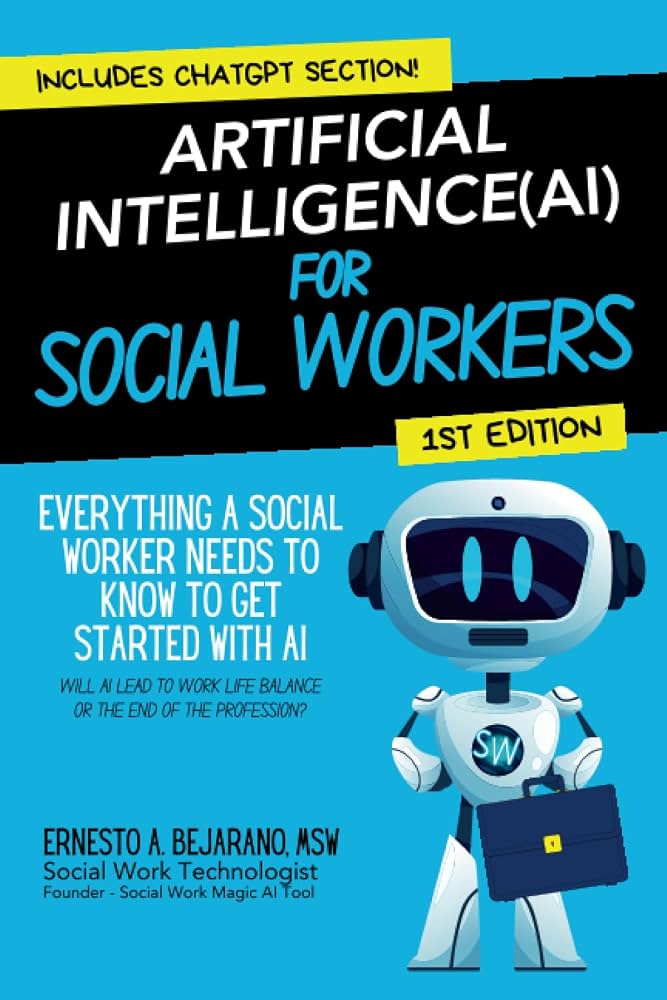
You need to be careful when you use images that represent actual things. First, the featured image that you use is a real book, self-published by Bejarano. It is not peer-reviewed and you don’t know if you want to promote it, right? I don’t know if the image is copyrighted or not, but when you are selecting that type of image, you should check.
Your point about oversight is great, but the real issue is when and how, right. Take a look at the outline and the chart for AI learning and it might help as you write your final project.
Dr P
Your second image is very interesting and a good resource. However, you don’t really talk about what they are suggesting, or apply it to the discussion in your post. I might have been a good addition to the conversation. In that case, the article is under public access and a Creative Commons copyright, so using it was fine – but you absolutely needed to reference it – either in the body or a reference list. Most importantly, you needed to talk about it if you were going to use it.