
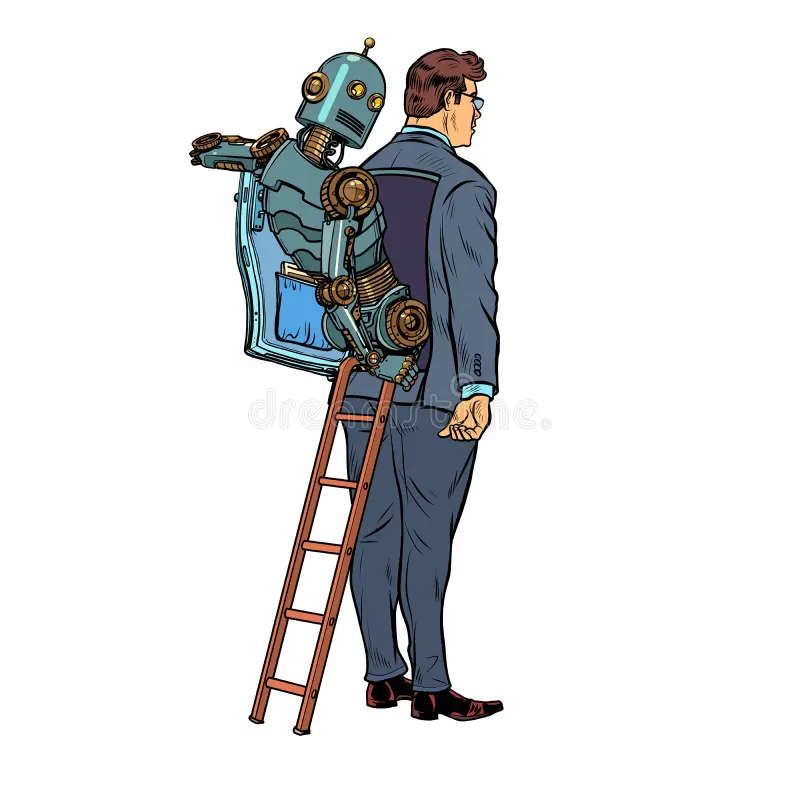

I found Kalota’s Primer interesting as it pulled the curtain back on AI. I believed that AI systems essentially just extracted data from numerous databases and resources, but I was intrigued by the concept of “unsupervised machine learning”. During this process, the machine essentially analyzes and organizes data based on patterns. This made me curious about how developers move forward after unsupervised machine learning to address or correct patterns that are incorrect.
I have encountered generative AI quite frequently. I have begun to see a phrase similar to “this information was produced using generative AI” when searching online or on different websites. I was recently searching for my job’s employee handbook and, when I used the search bar, I was given a summary with a generative AI warning. Similarly, I use Grammarly, which also offers a generative AI option. I have found that this is becoming widely popular.
If explaining to a client or colleague why AI tools may hallucinate or get things confidently wrong, I would explain that AI systems can only provide the information that is put into them. AI tools are not designed to decide whether they are considering all facts and truths or to express uncertainty. Instead, AI tools provide responses based on the information made available to them. In addition, pattern-based prediction is often built into these systems, so they will confidently respond even if they are wrong. This highlights the importance of being willing to continue our own research after using AI. In addition, much work remains to ensure AI systems receive accurate, ethical, and up-to-date information.
Before large language models (LLMs) were used with real clients, I would insist on further interdisciplinary collaboration to address stigma and bias. I would also like to see individuals being directed to human assistance with high-risk and sensitive topics. The findings of the article indicate that LLMs express stigma and are unable to provide trauma-informed, empathetic, and non-judgmental care. I believe that interdisciplinary collaboration would allow for a better understanding of how bias and stigma can manifest in multiple facets and must be challenged both technically and ethically. In addition, I would feel more comfortable using this tool if there were limitations on topics or concerns, so that those contacting it would be redirected to a human who can better recognize and address their needs.
I believe that AI is better designed for supportive, organizational, and logistical tasks. AI can be helpful with administrative tasks, providing definitions or fact-based information, and when a basic transcript can be followed. Moore et al.’s (2024) findings make it clear that in situations where human judgment, empathy, and full mental support are necessary, AI falls short. AI is unable to truly gauge the severity of mental health symptoms, acknowledge the risks of suicidal ideation, or challenge users. As a result, LLMs fail to provide users with a truly ethical and supportive experience. Instead, this can pose a danger to users, as Moore et al.’s (2024) findings indicate. I believe that, overwhelmingly, this article articulates that there are just some elements of the human experience which can’t be emulated.
For work, I currently handle calls that address quality concerns for products, including food, over-the-counter medications, and pet products. As a result, my day is often full of situations that may be accidents or the result of a lack of oversight. I’ve received reports of foreign objects found in food, short volume in medications, and more. Although not social work-related, I feel this still speaks to the importance of human oversight, which translates across multiple fields.
Score 8/10
Stigmas and bias are one of the main reasons that AI cannot help in ways humans can with it comes to mental health. I’m glad to see I’m not the only person who sees this as an issue in this class. Maybe I missed it, but I did not see the more or less AI in social work question answered.
Brianna,
The way AI functions is complicated and the articles are dense. It is so different from a search engine. I think if you take a look at the documents I have added to this week;s module, you will have a better idea of how it works and it will help you as you write your final project.
Ai systems respond with bias because theya re trained on huge datasets that are, basically, all of the information we humans have created. And we humans are biased, some more than others. All a LLM can do is share information that it has been trained on. If you look at how machines learn, I think that will explain it better than I can here.
The issue is how to find that line between supportive services and clinical, human intervention. It’s not an easy question.
Dr P