

Part 1 — Through the Reamer Lens
It’s really important to maintain digital boundary issues in Social Work. While reading the article, I found myself relating to many of the scenarios described. The article talked about a situation in which a social worker became concerned about a client’s emotional well-being after seeing several posts on the client’s social media, and decided to reach out to the client by sending private Facebook messages to inquire about their emotional state, and ended up exchanging messages online for nearly two hours. From my perspective, it is inappropriate to go through or engage with clients on their personal social media accounts. Although the social workers’ concern for the client’s well-being is understandable, I believe this approach crosses professional boundaries and raises ethical concerns. Contacting clients outside of established work hours, especially late at night, further complicates the situation. The social worker should wait until the next business day to follow up with the client.
The article also discusses how boundary issues often arise when professionals face conflicts between their professional responsibilities and personal lives. In my own experience working at a refugee resettlement agency, I have encountered similar challenges, especially since many clients come from my own community. This overlap sometimes led clients to approach me outside work hours to discuss their situations. Despite my efforts to maintain clear boundaries by providing clients only with my work phone number, clients from my community obtained my personal phone number and reached out to me outside of work hours. This often happens because personal contact information can be easily shared among community members. As a result, it became challenging to fully prevent clients from accessing my personal space. This situation created problems, such as feeling obligated to respond to messages at any time, experiencing interruptions during personal time, and struggling to maintain a healthy work-life balance. Sometimes it also puts me in uncomfortable positions where I had to remind clients of appropriate boundaries without damaging trust or the sense of community. These experiences have highlighted for me the difficulties social workers face when serving their own communities, and the importance of reinforcing professional boundaries.
Part 2 — Haidt in the Room with Your Clients
Phones are now very easy for young people to use, and even though there are some benefits, I think the negative effects are much greater. The TEDTalk pointed out that more people are worried about how smartphones and social media affect young people as they grow up. I believe we should have laws like Australia’s, where you have to be at least 16 to open a social media account. This could help kids enjoy a real childhood without the stress and distractions of being online. The problem is not just with kids, though. Many parents spend a lot of time on their phones, often without noticing how their habits might affect their children. They might not see how too much phone use can hurt their child’s social skills, attention span, and development. For example, I know a child who cannot spell simple words, but he can use the audio search to find videos online. Depending on technology like this is making both kids and adults less active and less likely to learn or solve problems on their own.
As people rely more on their phones, basic skills are getting worse and it is making everyone a bit lazier. Kids and adults are not as present in their daily lives and are missing out on real conversations and experiences. To fix this, we need to teach people more about the risks of using phones too much, especially for kids. Parents, teachers, and communities should work together to set good limits and encourage activities that help with learning, creativity, and real-life social skills. If we do this, we can help protect the well-being of future generations.
Hey Cho!
Thank you for your thoughtful post. Navigating your boundaries when serving your own community gets complicated. Reamer doesn’t say much about that, but I think practitioners who serve their own communities, especially ones that share their culture and possibly their language, carry a weight that is difficult to navigate. One thing I keep thinking as I’m reading the articles and doing this assignment is that it is best being upfront with your boundaries from the start, not just with clients but with other community members too, explaining the NASW ethics you must follow. That way it doesn’t feel personal if your work number during working hours is the only way to reach you. Though I imagine even that gets complicated in a tight-knit community. I would struggle with the same thing if I were in your position.
As for Part 2, I wonder what would happen if you took Haidt’s evidence and applied it to the refugee families you already work with. My guess is that early in resettlement, social media might be helpful, connecting people to family back home and helping them build a new community. But over time, as the algorithm learns what holds their attention, the same platform could turn into the trap Haidt describes. He treats social media like it’s uniformly harmful, but I think for populations who are new to it, the harm might build slowly rather than showing up right away. In my experience, having lived through the introduction of social media, it was a genuinely beneficial thing in the beginning, up until it wasn’t. I’d be curious to hear about what you have seen, if anything, about social media among refugees. I also agree with you about the age-16 policy in Australia. In my own life, social media made my mental health a lot worse during a hard time, and I think protecting developing brains is one of the strongest parts of Haidt’s argument.
Cho,
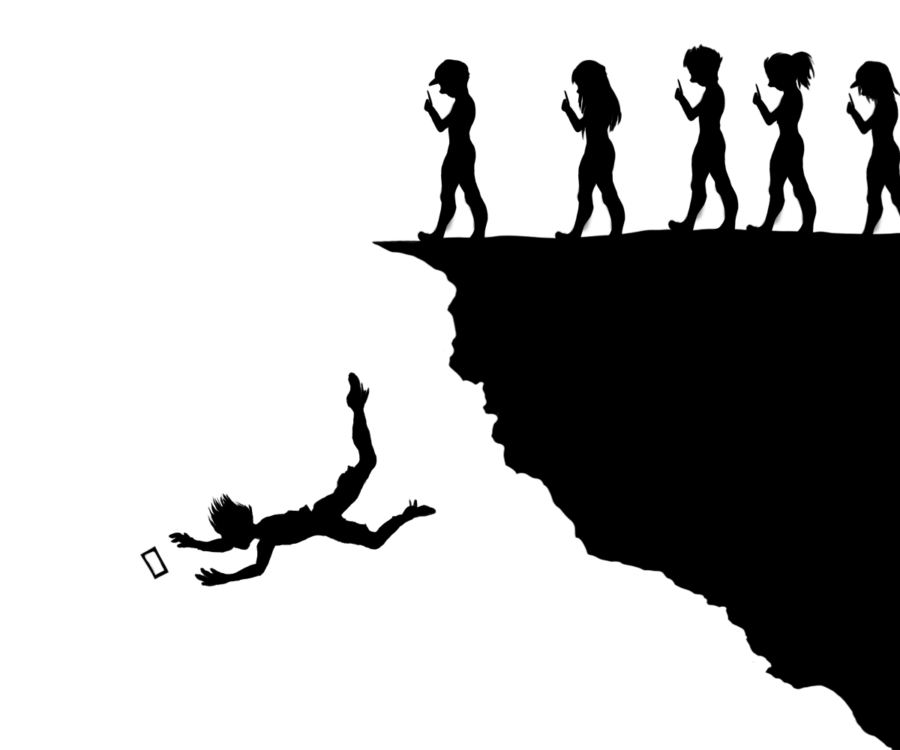
I love the image, by the way. Great visual of this issue. I think it is important to separate connections with clients on personal social media from those on organizational tools that may include social media. As we move forward in AI, I suspect we will see more and more tech utilized to connect with clients, and we will have to work hard to be clear about what is expected in terms of work/life balance.
Thank you for sharing your experience in a refugee resettlement agency. I have heard social workers talk about similar issues when they are in recovery and working in a recovery program. Those lines become really difficult to manage. I hope you had some supervisory help dealing with that, because it would be hard to manage alone. It would be reasonable for clients to assume that you were working in that organization because of your personal connection to the issue, so clients would initially assume there were no boundaries. Having to help them (and yourself) define those and then communicate them is more than a notion. That would be difficult.
I would agree that the seduction of social media happens to all of us, right? NO matter how much I think I am regulating my behavior, I suddenly look up and realize that I have fallen down the black hole – or something or other. I recommend the Center for Humane Tech. humanetech.com. THey have advocated for a different kind of tech development, and it would help all of us if we could embrace that reality – at least after this administration.
Good discussion.
Dr P