

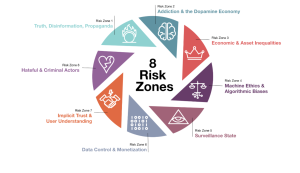
Zone 2: Addiction and the Dopamine Economy
The two examples that came to mind for this zone were the poem “It was the Damn Phones” and the documentary “The Social Delima”. It is important for social workers to think deliberately about the impact of websites and apps that create an addiction through the release of dopamine. Both of these pieces of art speak to the risks kids and teens are exposed to with their constant use of screens. Screens can have developmental impacts on all of our minds, but especially to developing brains. When we are exposed to a constant onslaught of dopamine through little computers in our hands, it can be hard to get the “fix” we need from anywhere else. As social workers we need to work to educate parents and our younger clients on the dangerous impacts of these devices. A young adult I was speaking to recently told me that having a phone at such a young age “ruined” her life. We must protect young minds from the app developers that want them to stay addicted.
Zone 3: Economic and Asset Inequalities
When thinking about this zone, I knew I needed to discuss AI and telehealth. In Digital Transformation in Social Work they discussed how technology gives us the ability to work with folks who may not be able to be reached otherwise. While this is true, we need to recognize that not everyone has access to the tools necessary for this practice. These days, it is so easy to assume that everyone has access to the internet. While many of us do, some still are left without. As many Americans are facing economic strife, the cost of living skyrocketing, we must think critically about the way we make ourselves available to help and that tech does not solve all problems. While some can access computers and the internet at libraries, those who live in more rural areas can have access issues that have nothing to do with finances. Rural access to the internet is incredibly hard to come by, is very expensive and, even when you can afford it, is spotty at best. These same issues can be discussed when looking at A Generic Review of Integrating Artificial Intelligence in Cognitive Behavioral Therapy. While they are attempting to mitigate these issues of access, we also need to be aware of all of the ways AI can be dangerous in this space. AI cannot read the nuisances of a human being. It is programmed to tell you what you want to hear. While I commend those programmers who are working towards a more accessible and just world. The use of AI in this space is incredibly dangerous and can leave those who have a hard time accessing mental health care when needed, with the wrong type of care.
Zone 4: Machine Ethics and Algorithmic Biases
Again this zone has me thinking on telehealth and AI. In Integrating Telehealth Services in Social Work Practice for Vulnerable Groups and Adapting Clinical Skills to Telehealth: Applications of Affirmative Cognitive‑Behavioral Therapy with LGBTQ+ Youth we are beginning to dig into the realities our most vulnerable live with and how tech can help. With any telehealth we need to be concerned about who has access to the data it is collecting, where records are being stored and safeguards for anyone who could be at risk for being vulnerable and asking for help. While these advantages are tremendous for folks, we need to stay aware of what biases we may hold and how access and safety shifts for those in different life circumstances. Data mining is real and when we look to our most vulnerable, the risks they face can be far greater than others. As Social Workers we need to check into everything we recommend to those we work with.
Zone 8: Hateful and Criminal Actors
Once again I am thinking about “The Social Dilemma” and how our children are exposed to dangers online. In the documentary I was struck by all of the parents talking about worries of child safety out in the world, but not online. The online risk is SO much greater, yet we seem to overlook that fact. It is far more likely someone will target your child online than walking with friends in the park. I was also thinking a bunch about AI in this zone and the podcast we watched/listened to Could AI Go Rogue? The idea that developers are working towards a sentient intelligence is absolutely terrifying. It definitely seems like something nefarious actors would be able to utilize in many different ways. As social workers, advocating and educating about these dangers is incredibly important. We must work for the good of our communities and practice with a whole person, whole community, eye.
Miranda,
Really nice job on this post.
Dr P