

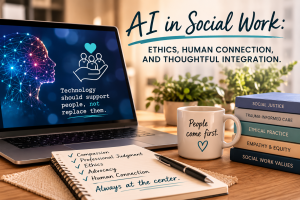
If someone had asked me seven weeks ago whether AI belonged in social work, my answer probably would have been a quick “no.” Not because I understood AI well, but because I didn’t trust something I knew so little about. After spending this semester reading, discussing, and honestly wrestling with the topic, my answer isn’t nearly as simple anymore. I still have concerns, but I’ve learned that the better question isn’t whether AI belongs in social work. It’s whether we can use it in a way that protects the people we serve while staying true to our professional values.
One of the biggest things I took away from Kalota’s article was realizing that AI isn’t actually “thinking” the way people think. Before this class, I assumed AI searched for the best answer the way I search the internet. I didn’t understand that generative AI predicts responses based on patterns it learned from enormous amounts of data. I won’t pretend I understood every technical detail in the article, but I understood enough to realize that AI isn’t exercising judgment or reasoning. That completely changed how I think about using it.
Looking back, I realize I’ve been using generative AI throughout graduate school without fully understanding what was happening behind the scenes. I’ve used it to help organize ideas, brainstorm assignments, and improve the flow of my writing. Before learning more about how AI works, I probably gave it more credit than it deserved. Now I see it differently. AI can absolutely help me become more organized and efficient, but it should never replace my own critical thinking or professional judgment. If anything, learning how it works has made me more comfortable using it because I also understand its limitations.
If a client or coworker asked me why AI sometimes “hallucinates,” I would keep my explanation simple. I’d probably say, “Imagine asking someone to finish your sentence after they’ve read millions of books but have never actually lived any of the experiences they’re talking about. Most of the time they’ll make a pretty good guess, but sometimes they’ll confidently fill in the blanks with information that sounds right even when it isn’t.” That’s why I think AI should always be viewed as a tool that needs human review, not as an expert that should be trusted without question.
While Kalota helped me understand how AI works, Moore et al. challenged me to think about how AI should and shouldn’t be used in social work practice. Reading about stigma and inappropriate responses made me think about my own work as a Housing Support Supervisor. Every day my team relies on technology like Avatar, Zendesk, Teams, and electronic documentation to provide services. Those systems help us stay organized, but they don’t replace our professional judgment. When a client is facing eviction, a mental health crisis, or housing instability, there is always more to the story than what a computer screen can show.
If my agency decided to use AI for something like intake screening, after-hours support, or providing basic community resources, I wouldn’t automatically oppose it. However, I would insist that there be clear boundaries around what AI is allowed to do. One safeguard that I think is absolutely necessary is meaningful human oversight. AI could help gather information, answer routine questions, or connect clients with available resources, but it should never make decisions about a client’s level of risk, eligibility for services, or safety. Those decisions require empathy, context, and professional judgment that AI simply cannot provide.
I’ve also learned that human oversight isn’t just important for AI, it’s important for every system we use. Throughout my career, I’ve seen situations where policies or electronic systems didn’t fully capture what was happening with a client. Without someone willing to ask more questions and look beyond what was on the screen, clients could easily fall through the cracks. Moore et al.’s findings reinforced that concern for me. AI can reflect bias, misunderstand context, or provide responses that sound convincing but are ultimately harmful. That’s exactly why social workers need to remain actively involved instead of assuming technology will always get it right.
This course didn’t convince me that AI is the future of social work. What it did convince me of is that social workers need to be part of the conversation about AI. These tools aren’t going away, and pretending they don’t exist won’t protect our clients. Our responsibility is to ask the hard questions, advocate for ethical safeguards, and make sure technology supports,not replaces the human relationships that are at the heart of our profession. If there’s one lesson I’ll carry with me after this class, it’s that ethical social work practice isn’t about resisting technology. It’s about making sure technology never replaces compassion, critical thinking, and the dignity every client deserves.
Tammara,
You did a great job discussing Kalota – and I certainly understand whyyou thought it was a search engive – so did everyone else. I think we used what we are familiar with to explain what we didn’t understand. And I am glad that you will utilize it differently now that you understand how it works. Remember, even though Gen AI is using data that is was given to answer, the data is voluminous and comprehensive. That doesn’t solve the error problem, but it helps us understand why it seems to be able to think, right?
I really liked your description of hallucinations. I think it was a perfect description.
Your discussion of Moore and how to manage the use of AI is also right on the mark. The problem, as I am sure you see, is how do we find the line between support and clinical intervention and then how to we establish safeguards to protect that line.
Take a look at the additional documents I added to this week’s module. I think they will enhance the already good work you have done to better understand AI>
Really good discussion
Dr P