

Part 1
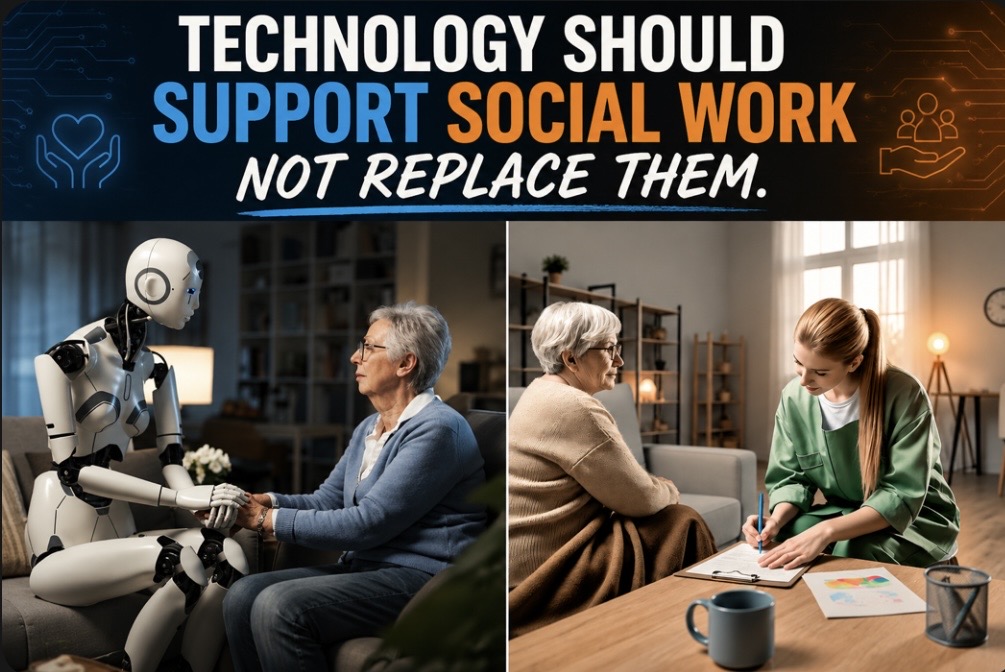
As I reflected on Reamer’s article, I found myself asking one important question: Can AI truly do the job of a social worker without personal contact or social engagement? From my perspective, the answer is no. While I believe AI can improve efficiency, organize information, and serve as a valuable learning and administrative tool, I do not believe it can replace the empathy, compassion, ethical judgment, active listening, and genuine human connection that define the social work profession.
The ethical issue that makes me most uncomfortable is the possibility that social workers could become too dependent on AI when building relationships with clients. I believe trust develops through empathy, compassion, active listening, and genuine human interaction not through technology. While AI can support administrative tasks and improve efficiency, it should never replace the unique bond that social workers are responsible for creating with their clients. To me, the relationship between a social worker and a client is built through understanding, respect, and authentic connection, which are qualities that AI cannot replicate. I believe preserving that human connection is essential because social work is rooted in respecting each client’s dignity, individuality, and lived experiences. Social work is about connection and social engagement. People heal, grow, and process their experiences over time through relationships with others. Technology can be helpful for generating ideas and improving efficiency, but it cannot replace the compassion, empathy, and genuine human connection that define the social work profession.
Although I have not encountered this issue in a social work placement yet, I have experienced a similar situation in my personal and academic life. I use AI to help me understand and interpret complex subjects that are not always easy to grasp. I build my own perspective based on the knowledge I have acquired, my own thoughts, emotions, and personal experiences that AI cannot help with. A few assignments I have a difficult time with are structuring my papers into chronological order, developing a strong thesis statement, and building my paragraphs. I have a great skill in free writing because I think and write as I go. Sometimes my ideas flow really well, but other times they become misplaced or out of order. After AI gives me clarification, I often ask for examples or ask it to explain concepts in simple terms by breaking them down into smaller parts so they are easier to understand. This helps me organize my thinking, but I still develop my own ideas and write in my own voice.
I have also noticed that AI sometimes gives inaccurate information, which is one reason I do not rely on it completely. If I know the information is incorrect, I correct AI, and it often responds by acknowledging the correction and providing more accurate information. That experience has taught me that AI is a helpful learning tool, but it is not always factual or guaranteed to be correct one hundred percent of the time.
From my own perspective, I believe relying too heavily on AI can lead people to seek constant validation for their thoughts, emotions, and decisions instead of trusting their own judgment. I also believe both humans and AI have limitations. Human beings can experience stress, burnout, fatigue, and emotional exhaustion, but they are capable of learning, growing, reflecting, and showing empathy. AI is still technology. It can misinterpret requests, generate false information, rely on outdated information, or malfunction. For that reason, I believe no one should rely completely on AI, especially in social work.
I agree with Reamer that AI can improve efficiency and be a useful resource when it is used ethically and responsibly. I also agree that social workers should always protect client confidentiality and use their own professional judgment when making decisions. However, I think there should be even more emphasis on preserving the human relationship between the social worker and the client. Based on my own experience, my view is that AI should be integrated into social work in the same way I view a tutor. As a tutor myself, I cannot write a student’s paper or complete their homework for them. Instead, I ask questions, encourage them to use their critical thinking skills, and help them better understand concepts so they can develop their own opinions, ideas, and conclusions. I believe AI should serve a similar purpose for social workers. It can help organize thoughts, structure documentation, brainstorm ideas, and improve the clarity of progress notes or other written materials, but it should never take accountability for clinical documentation or make decisions about a client’s care. It should not provide treatment recommendations, offer therapeutic advice, or determine the direction of a client’s services. Those responsibilities require ethical decision-making, critical thinking, empathy, and an understanding of each client’s unique circumstances. AI should challenge practitioners to think beyond the basic concepts rather than think for them. In my opinion, AI should remain a supportive learning, writing, and organizational tool, while the social worker remains fully responsible for every assessment, recommendation, and decision included in a client’s record.
If I had to explain my ethical position to a client today, I would tell them that my priority is building a trusting relationship through honesty, empathy, respect, and active listening. If I ever used AI to assist with organizing documentation or other administrative tasks, I would carefully review everything myself, protect their confidentiality, and ensure that every decision about their care came from my professional judgment not from artificial intelligence. I would explain that AI is simply one resource that helps me organize information, but it could never replace the relationship we build together. My goal would always be to make sure my clients feel heard, valued, respected, and understood by me as their social worker, not by a computer.
Part 2
As I reflected on Haidt and Rausch’s article and Haidt’s TED Talk, I found myself asking one important question: Are there beneficial effects of technology? From my own perspective, the answer is yes, but only when it is used responsibly and in moderation. I believe technology has both benefits and risks. It can make learning more accessible, encourage creativity, provide educational resources, and help people stay connected. However, I also believe technology should never replace personal connection, face-to-face interaction, or real-life experiences. Those are essential to healthy development, especially for children.
After reading Haidt and Rausch’s article and watching Haidt’s TED Talk, I immediately thought about children in school settings because that is the population I hope to work with as a future social worker. I am drawn to working with children because I am curious about how they think and develop certain skills and learning strategies at a very young age. I believe childhood experiences have a major impact on a person’s life overall, and many childhood memories become something they value throughout their lives. This is one reason I believe children are one of the most vulnerable groups when it comes to social media.
One of the most influential platforms today is TikTok, along with YouTube, Instagram, and Twitch. Every day, I see people trying to fit the lifestyles of influencers and artists, which can create a false narrative about what life should look like. From my own experience, there have been times when I had to withdraw myself from social media because it became emotionally draining. I started questioning my self-worth, became insecure, lost focus, and developed an obsession with wanting to be perfect while still trying to appear unique by mimicking other people’s lifestyles. During doctor visits, school pick-ups, at the kitchen table, or even during quality time with family and friends, I often notice people distracted by their phones. Haidt’s research helped me better understand why these behaviors are becoming more common and how social media can influence a child’s identity, self-esteem, and relationships.
As a future school social worker, I would ask students about their daily screen time and how social media affects their self-esteem, confidence, relationships, and overall well-being. Rather than making assumptions, I would create a discussion panel where students could openly share who they follow, what platforms they use, why they enjoy them, and how those platforms influence the way they think about themselves and others. I believe listening to the youth’s personal experiences is more valuable than making assumptions about what they are going through. When appropriate, I would also share my own experience with social media so they know they are not alone. I would encourage parents and educators to create more opportunities for face-to-face interaction while also modeling healthy technology habits because children often learn by observing the adults around them.
Although I agree with many of Haidt’s concerns, I also believe social media has both its benefits and its risks. I see this as an opportunity to integrate technology into education because that is how many children learn faster, easier, and in ways that are more accessible. However, I also believe personal connection, face-to-face interaction, and real-life experiences are essential to a child’s development and education. My goal would not be to eliminate technology but to help children and families develop a healthy balance between their online and offline lives while continuing to value genuine human connection.
Hi Seqouyah, Thank you for your post. While I agree that ai cannot replace the job of a social worker efficiently, I do feel that it can replicate a lot of the key points you mentioned. For example, I have noticed how many ai services will retain information from multiple conversations and personalize a lot of the content. I encourage everyone to get a visual of how it can replicate empathy, however it is not as effective as the human interaction necessary. I think it is worth noting how some may feel more comfortable communicating with ai as it can feel less judgmental. I feel it is very important for future practitioners to continue to push against ai because of this.
Hi Seqouyah,
I like your point that AI should only be used as a support tool and not replace the relationship between a social worker and a client. One thing I would challenge is the idea that technology always weakens human connection. During my placement at Carrie Steele Pitts Home, I have seen technology help us stay connected with foster and adoptive families by sharing resources and communicating about workshops. It doesn’t replace face-to-face relationships, but it can strengthen them when used appropriately. Your reflection also made me think about Haidt’s discussion of the importance of play and independent social experiences for children. While you focused on social media’s effects on self-esteem, I think his point about children losing opportunities for real-world interaction is also important because those experiences help build confidence, problem-solving skills, and healthy relationships.
Hello Seqouyah!
I agree that AI cannot replace the work of a social worker. I believe it is a helpful tool for organization and brainstorming, but it cannot replace the human connection that social work is built on. In Haidt’s TED Talk, he says that humans are “ultrasocial.” We are wired to build relationships, connect with others, and learn through real human interaction, even if it is something as simple as walking side by side with another person. That is something AI simply cannot replicate. I think empathy, trust, and genuine relationships are at the heart of social work, and those qualities will always require a human being.
I also really liked the perspective you brought up about relying on AI for constant validation. I know people who use AI almost like a therapist and constantly ask it for reassurance. I think that can sometimes cause people to doubt their own judgment instead of learning to trust themselves.
Seqouyah,
We will discuss the role of AI in social work practice in the next module, and I think you will find it interesting. I don’t think anyone is suggesting that AI should replace social workers, and, in fact, you will read an article that explains exactly why LLMs (Large language models that make up AI) shouldn’t be put in that role. I am impressed with the ways you have learned to utilize AI in your professional development. I suspect, then, you can always see how easy it would be to move that line further toward letting AI do more?
In my AI-Aware class, which I mentioned in my overview for the next blog post, I am learning about ways to structure classes to give students a clear outline of what to expect. But there are also times when I would suggest that even that changes your mental process. The hard figuring out – the work that forces you to use your brain in new ways that you haven’t before – frequently gets outsourced to AI. I keep reading about this new technology and how it is changing how we think. I don’t have any answers, but I appreciate your focusing the questions. I learned a lot from your sharing your process.
I think Haidt and Rausch, through their research, have provided a different picture regarding how much technology has helped our children learn. I think they would suggest that the opposite is true. I think in some ways, suggesting we use just a “little” social media is like telling a person living with an addiction to just use a little of that stuff to which they are addicted. And, to be perfectly honest with you, I think “influencers” are the evil of our present reality. – Sorry, I guess that’s a bit extreme, but I have seen so much damage done by the false image of perfection.
I have my own experiences with the inability to stop social media. That is the purpose in the design. But it really can be designed differently. I recommend you take a look at the Center for Humane Tech, particularly since you are interested in school social work. https://www.humanetech.com/ I think you would appreciate their work. You do a good job of discussing how these issues that Haidt and Rausch raise are important not just for youth, but we are all struggling to find our way.
Social Media is presently structured to keep you engaged for as long as possible. They have actually learned the statistical process that most efficiently accomplishes that goal. That is the reality of this technology. In terms of devices generally, I understand your hesitation at saying no devices anywhere, anytime. I’m not sure that is what Haidt and Rausch are saying either. I think his point is that 1-to-1 devices at an early stage of child development do not support social development or learning.
Good discussion. Thank you for sharing.
Dr P